Showing posts with label Places. Show all posts

Wednesday, January 23, 2013

Ebenezer Alden & Early Settlement in Union

I was in the town of Union over the weekend and passed the town common and many old homes in the village area near it. This reminded me of reading the book, Come Spring (Ben Ames Williams, 1940), a fictional account of the Robbins family and early settlement of the town. If you haven't read this book, give it a try. It was painstakingly researched for historical accuracy and gives the reader a feel for what it might have been like to arrive in the Maine woods in the late 1700s. I particularly remember reading about the men spending months clearing land, day after day cutting trees with hand-saws. What did those old, relatively undisturbed woods look like? I was also struck by the realization that the primary means of travel was by water rather than land - boats on the rivers in warm weather, and sleighs across the ice in winter. The Union historical society offers a printed, self-guided "Come Spring" tour and you can visit some of the locations from the book, such as the old homesteads and the cemetery.

The Old Townhouse, Union, Maine
(Photo by author)
The first white settlers to the area were three men of Scottish origins who arrived in 1772 and called their logging camp "Sterling." The town officially formed in 1786 with the name of Union.

Founding families include: Adams, Bowen, Butler, Cummings, Grinnel, Hawes, Holmes, Hills, Mero, Partridge, Robbins, Ware, and Wheaton. Union boasts the oldest public common in the state; records indicate the Common was established by 1790. Many old homes have been preserved, including the Robbins house, the Old Townhouse (built in 1840 as the town meetinghouse in the New England tradition, and now owned by the historical society), and the Ebenezer Alden house.

The Alden house stands tall and imposing on a hill above the Common, and is listed on the National Register of Historic Places. It's a beautiful house and has been carefully restored. I've seen it many times and was curious to learn more about its original inhabitant.

Ebenezer Alden House, Union, Maine (Photo: Union Historical Society)

Ebenezer Alden


Ebenezer Alden was from Massachusetts, born 20 September 1774 in Middleborough to Job and Lucy Alden.(1) He came to Maine as a young man to work as a carpenter during the construction of the Montpelier mansion in Thomaston. He decided to settle in Union and must have been quite enterprising, as he completed his house there by 1798 (just 24 years old), and operated the first general store in the town.(2) In 1799, he returned to Massachusetts to marry Patience Gilmore,(3) and the couple traveled to the home in Union. They had nine sons and three daughters: Horatio, Louisa, Silas, Selina, Lyman, Melina, Augustus, Ebenezer, James, Edward, Henry, and George.(4)

I did a quick search of online census records (Ancestry.com) and found Ebenezer's household in Union from 1810-1860: Ebenezer Alden is listed on the 1810 and 1830 censuses for Union with 10 household members (Ebenezer, Patience, and 8 children), 1840 with 6 household members, and then more detailed family listings in 1850 and 1860.(5)

In 1850, Ebenezer, age 75, and his wife Patience, age 68, had property valued at $15,000, a very large sum at that time. They were farming, and two of their grown sons lived in the home - Augustus (age 34, farmer) with his wife Margaret and two young children, and Edward (age 28, physician).(6)

By 1860, Ebenezer, age 84, was living in the home with his son Augustus and his family. Patience had died prior to 1860.(7) Ebenezer died two years later on August 10, 1862.

The home remained in the Alden family for several generations. Ebenezer's children moved to Camden, Thomaston, and Bangor, in addition to those who remained in Union.

Resources and Further Reading:


Union History:
Free Online Books:
The Alden House:
The Alden Family:

Sources:


  1. "Massachusetts Town and Vital Records, 1620-1988", database, Ancestry.com (http://www.ancestry.com : accessed 21 January 2013), entry for Ebenezer Alden, 20 Sep 1774, Middleborough; citing "Massachusetts Vital and Town Records, Holbrook Research Institute, Provo, UT."
  2. "Preserving the Ebenezer Alden House in Historic Maine," Patricia Poore, Old House Online, Fall/Winter 2011 article.
  3. "Massachusetts Town and Vital Records, 1620-1988," database, Ancestry.com (http://www.ancestry.com : accessed 21 January 2013), entry for Ebenezer Alden - Patience Gillemore, 24 February 1799, Middleborough; citing "Massachusetts Vital and Town Records, Holbrook Research Institute, Provo, UT."
  4. Alden Pedigree, Union Historical Society.
  5. 1810 U.S. census, Lincoln County, Maine, population schedule, Union, page 1, Ebenezer Alden; digital image, Ancestry.com (http://www.ancestry.com : accessed 21 January 2013), citing National Archives microfilm publication M252, Roll 12. 1830 U.S. Census, Lincoln County, Maine, population schedule, Union, page 244, line 16, Ebenezer Alden; digital image, Ancestry.com (http://www.ancestry.com : accessed 21 January 2013), citing National Archives microfilm publication M19, Roll 49. 1840 U.S. Census, Lincoln County, Maine, population schedule, Union, page 81, line 6, Ebenezer Alden; digital image, Ancestry.com (http://www.ancestry.com : accessed 21 January 2013), citing National Archives microfilm publication M704, Roll 144.
  6. 1850 U.S. Census, Lincoln County, Maine, population schedule, Union, page 251A, dwelling 74, family 82, Ebenr Alden; digital image, Ancestry.com (http://www.ancestry.com : accessed 21 January 2013), citing National Archives microfilm publication M432, Roll 259.
  7. 1850 U.S. Census, Knox County, Maine, population schedule, Union, page 231, dwelling 325, family 313, Ebenezar Alden; digital image, Ancestry.com (http://www.ancestry.com : accessed 21 January 2013), citing National Archives microfilm publication M653, Roll 443.

Tuesday, January 22, 2013

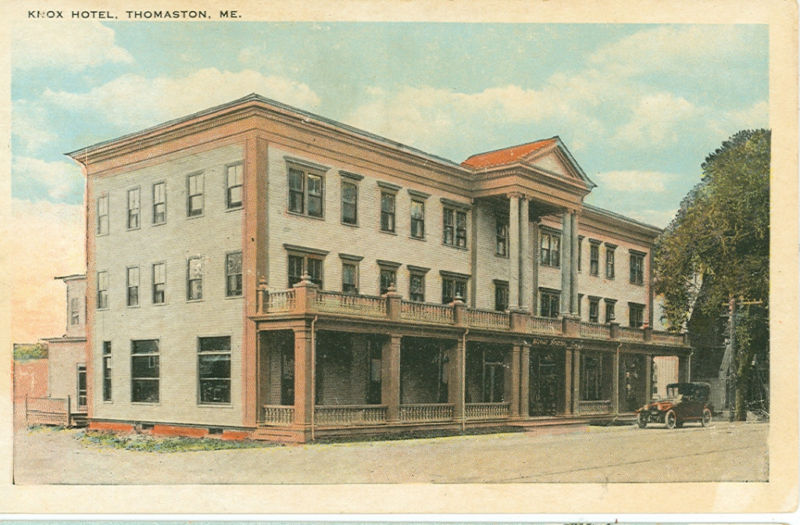
Knox Hotel, Thomaston

I was in an antique shop in Union over the weekend when an old book on the counter caught my eye. It was an old guest register from the Knox Hotel in Thomaston, Maine, with entries starting in 1881. Unfortunately, someone along the line decided to use the book as a scrapbook, and pasted newspaper clippings over all of the pages except the first one. What a shame!

What was the Knox Hotel? 


Knox Hotel, postcard image
The building, situated along the main commercial street in Thomaston, was originally a three-story wooden structure built in 1828 and operated as a hotel and tavern under several different owners in the 1800s. There was a stable behind the hotel. The name Knox Hotel, or Knox House, remained remarkably consistent through the years. The hotel was expanded in 1892 to accommodate an increase in summer visitors to the area. A fire destroyed the hotel in 1915 (along with several other buildings), but it was immediately rebuilt and continued to operate until 1966. A decade later it was renovated and redeveloped into an apartment building and office space.  Today, after further renovation, this building continues as a historic landmark along Main Street, housing Camden National Bank as well as apartments.

Resources:


Friday, January 18, 2013

Friday Firsts: First European settlement in Maine

"Friday Firsts" will be an ongoing theme, for posts about notable "firsts" in Maine history. This being the first "First," let's travel back over 400 years. Did you know that the first European settlement in Maine, and one of the earliest in North America, was in 1604? That is before Jamestown colony in Virginia (1607) and Plymouth colony in Massachusetts (1620). You've probably never heard of it because it didn't last, and because it was a French settlement rather than English.
Champlain's 1613 map showing St. Croix Island
(Source: U.S. National Park Service)

The settlement was on tiny St. Croix Island in the St. Croix river along what is now the U.S.-Canadian border. It was an early attempt by France to establish a permanent settlement in their Acadian territory (L'Acadie). The expedition was headed by French nobleman Pierre Dugua de Mons and the group of 79 men included the royal cartographer Samuel de Champlain, as well as a baron, a priest, the apothecary Louis Hebert (ancestor to thousands of French-Canadians), and Mathieu de Costa, a free black man who spoke multiple languages (including Mi'kmaq) and worked as a translator. During the winter of 1604-5, nearly half of the men died - many from "land-sickness," now believed to have been scurvy. The settlement was isolated on the tiny island, iced-in without sufficient access to fresh water or game. The survivors were able to trade with the Passamaquoddy people in the spring for food supplies.  In spring 1605, the settlement moved to Port Royal (now in Nova Scotia), which became the first permanent settlement of New France.

The buildings on St. Croix were burned by the English in 1613, and the island remained uninhabited for a long time. In the 1800s, it was settled for a time, quarried for sand, and a light station was built there. It is now a designated International Historic Site managed by the National Park Service - not accessible to the public.

Who was Pierre Dugua de Mons? 

Dugua (De Gua) was a Protestant French nobleman who was appointed Lieutenant General of L'Acadie and given exclusive rights by the French King to the fur trade there. In exchange, he was to establish colonies and bring 60 new colonists per year. The son of Guy Dugua and Claire Goumard, Pierre Dugua was born circa 1558 on the west coast of France. He married Judith Chesnel in 1597, a Catholic who brought a good sized dowry to the marriage that helped to fund his venture; they had no children. He was about 46 years old when he led the expedition to St. Croix, and he became wealthy through the colonial fur trading business. In 1607, his monopoly on the fur trade was revoked after protests by other merchants, causing him significant financial troubles. He left the Port Royal settlement and returned to France. Though he regained the fur trade monopoly in 1608, he never returned to the New World. He remained involved in the fur trade and the colonization of Acadia from a distance. He died in 1628 in France.

Sources and Further Reading:


Thursday, January 17, 2013

Learning in and about Belfast

Belfast Library, present day
Yesterday I attended a presentation at the Belfast public library: "Exploring Davis St. Families: An Introduction to Genealogy Research," presented by Betsy Paradis, the special collections librarian. This program was part of a monthly series arranged by the local chapter of the Maine Genealogical Society.

Sitting in the historic library building and visiting the town of Belfast inspired a post about the history of Belfast and resources for research.

Belfast is technically a city, but with a population of just 6,600, it feels like a small town. Its sits by the water, quiet Main street lined with brick buildings, and the city is noted for its beautiful old sea captains' homes and architecture. It's clear the town was prosperous in its shipbuilding days.

Belfast was settled in 1770 by Scots-Irish moving from New Hampshire. The settlers left during the Revolution for fear of British attacks but returned afterward and re-established the town. The harbor on Penobscot Bay and abundant timber led to a thriving shipbuilding industry and maritime commerce. In the 1860s, the town was connected to the Central Maine Railroad, which boosted local businesses. In the 1900s, the maritime industry declined and was replaced by factories and processing plants. More recently, the town has been revitalized as both a tourist destination and a hometown with a flair for arts and culture.
Main Street, Belfast, 1921 (Source: Wikipedia.com)

Research Resources:

Belfast Historical Society and Museum:
Free monthly programs and presentations, April-October, also available ONLINE (check out the archive of past programs!). Museum open during the summer or by appointment.

Belfast Free Library:
The special collections area on the third floor includes old newspapers on microfilm, family histories, historical records, photos, maps, and school yearbooks. View complete list of holdings.

Penobscot Marine Museum:
A terrific museum of Maine maritime history, located "next door" in the town of Searsport. The museum includes ten historic buildings, photo archives, historic boats, marine art, and a shop. If you can't visit in person, try the virtual exhibits for lots of historic photos. The museum also offers Penobscot Bay History Online, featuring history of the area and a searchable collection of old photos, documents, and maps, and three journals chronicling sea voyages from Belfast. These websites could keep you busy for hours. The museum itself is open primarily in the summer months.

Railroad History: The Belfast and Moosehead Lake Railroad

Belfast genealogy resources on MaineGenealogy.net:
Online maps and records of births, marriages, deaths, town reports, voter lists, and more.

Belfast historical photos on Maine Memory Network

Search Belfast newspaper archives (1820-1838): GenealogyBank

Free online books: